Devotion
The cult of Mary rose
Because chivalry needed an aim
And the grail was not enough
A lifestyle was needed
A reason for the knight to rise, go
After dragons every day
In every breath a reason
That became the lady
It could have been a good thing, I suppose
Maybe was
Maybe some curtailing of violence happened
But she became an object, still
Mary and all women
Something to adore, perhaps
Something to report to,
Still a thing
If women could be knights
And, who knows, they might have been
They might have taken it up with her
A real reason, real cause
Not dragons but equality
Real beasts to slay
A crusade not against western Asia
But with one’s own country
Until one’s own had real faith
In strength
And in conviction
The kind that makes sense out of armor
That gives a blade a reason
To be shined and ready
Humanity
Divinity
Belief in everything that shines
And lasts
C L Couch
The 12th and 13th centuries saw an extraordinary growth of the cult of the Virgin in Western Europe, inspired in part by the writings of theologians such as Bernard of Clairvaux. The movement found its grandest expression in the French cathedrals, often dedicated to “Our Lady”, such as Notre-Dame de Paris and Notre-Dame de Bayeux among others.[70] Walsingham and other places of Marian pilgrimage developed large popular followings. At the height of the pilgrimage movement in the 11th and 12th centuries, hundreds of people were traveling almost constantly from one Marian shrine to the next.[71]
70 Department of Medieval Art and The Cloisters. “The Cult of the Virgin Mary in the Middle Ages”. The Metropolitan Museum of Art.
71 Renaissance and Reformation by William Roscoe Estep 1986 ISBN 0-8028-0050-5, page 7.
https://en.wikipedia.org/wiki/Veneration_of_Mary_in_the_Catholic_Church
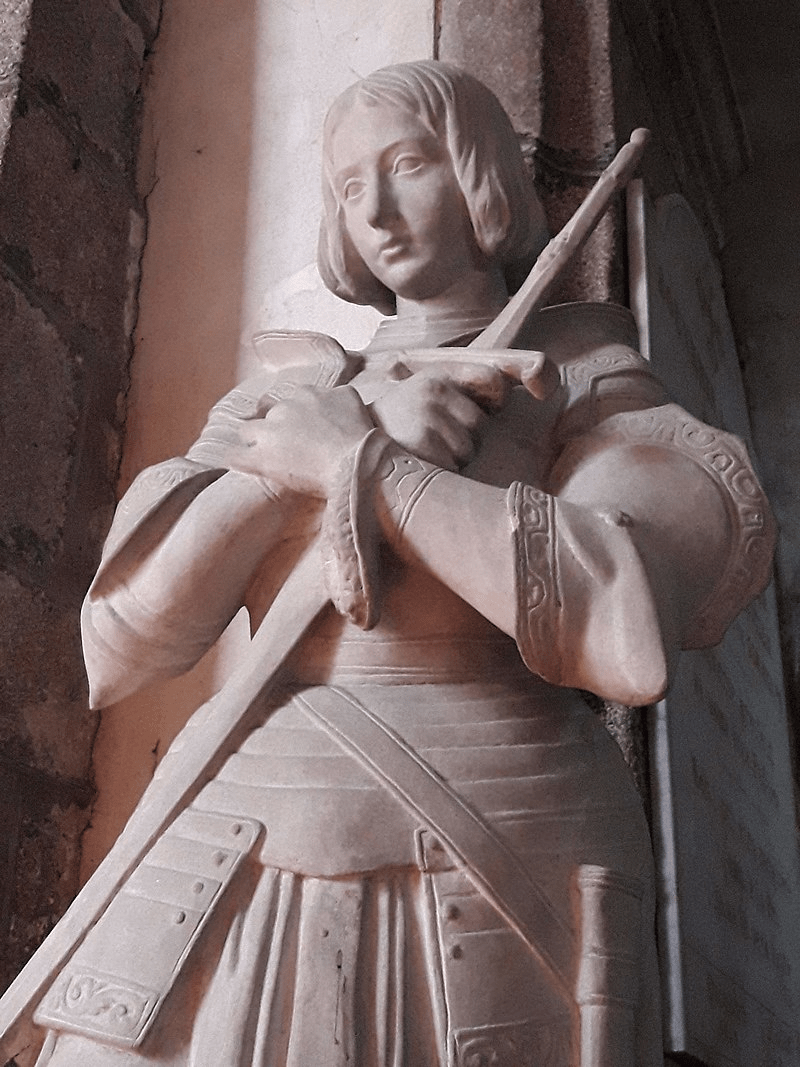
Joan of Arc (French: Jeanne d’Arc[3][4] pronounced [ʒan daʁk]; c. 1412 – 30 May 1431),[5] nicknamed “The Maid of Orléans” (French: La Pucelle d’Orléans), is considered a heroine of France for her role during the Lancastrian phase of the Hundred Years’ War, and was canonized as a Roman Catholic saint.
3 Her name was written in a variety of ways, particularly before the mid-19th century. See Pernoud and Clin, pp. 220–21. Her signature appears as “Jehanne” (see www.stjoan-center.com/Album/, parts 47 and 49; it is also noted in Pernoud and Clin).
4 In archaic form, Jehanne Darc (Pernoud Clin 1998, pp. 220–221), but also Tarc, Daly or Day (Contamine Bouzy Hélary 2012 pp. 511; 517-519).
5 An exact date of birth (6 January, without mention of the year), is uniquely indicated by Perceval de Boulainvilliers, councillor of king Charles VII, in a letter to the duke of Milan. . . .
https://en.wikipedia.org/wiki/Joan_of_Arc
after Marie d’Orléans – Eglise de Saint-Pair-sur-mer
Prokofiev – Own work, CC BY-SA 4.0, https://commons.wikimedia.org/w/index.php?curid=74909310

 clcouch123
Recent Comments